What Is Repmold?
Repmold is a term that has appeared online in connection with mold replication, rapid tooling, reverse engineering, and digitally assisted manufacturing. However, it does not have one universally accepted technical definition. Different sources use the word to describe different ideas, including mold reproduction and modern production workflows.
That distinction matters because unfamiliar manufacturing terms are easy to overstate. Some online pages present Repmold as a defined technology, while others describe it as a general approach to reproducing molds and components. A reliable explanation should separate established manufacturing techniques from claims that are not independently documented.
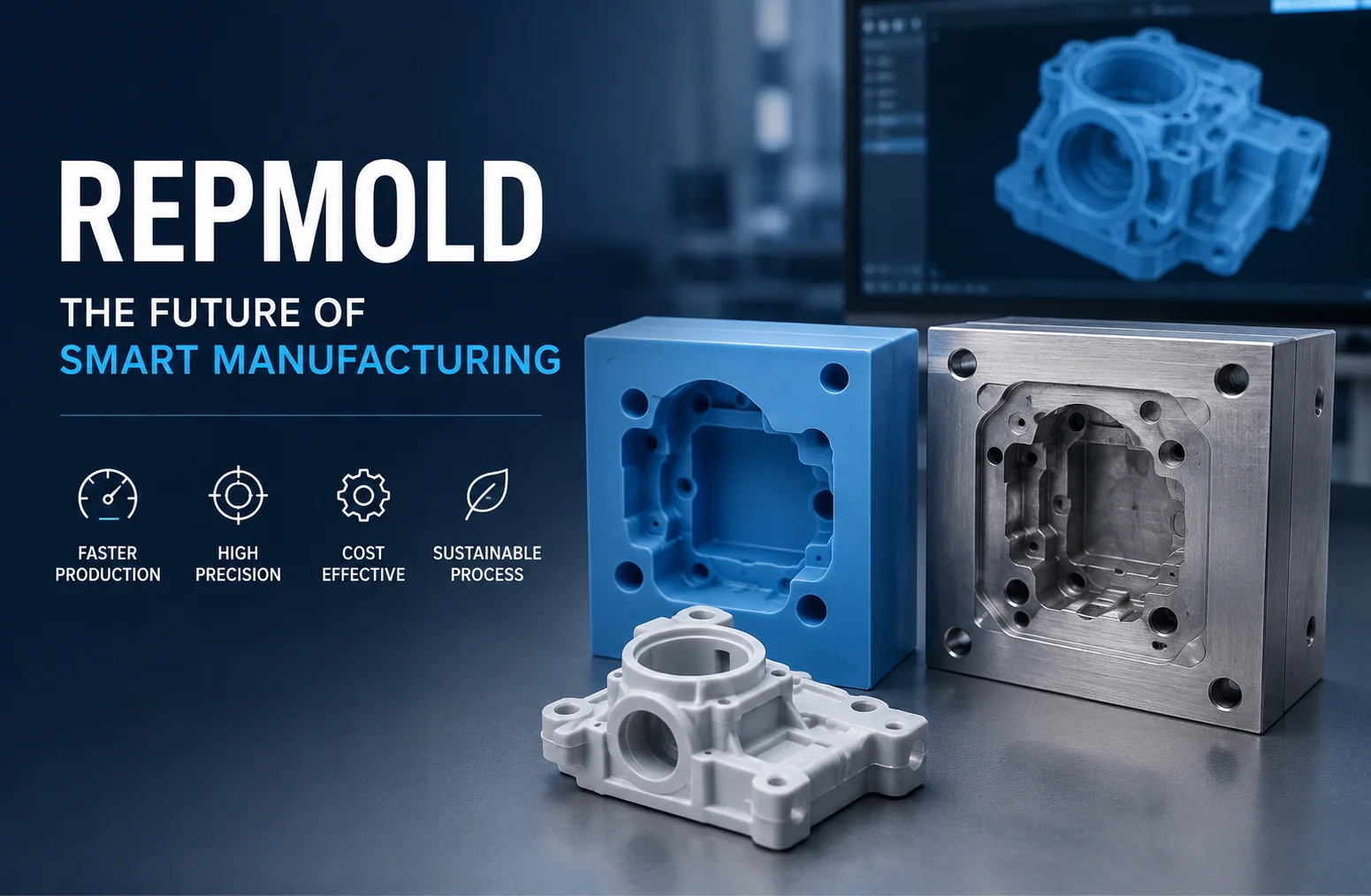
In practical terms, the most useful interpretation of repmold is a workflow focused on reproducing, rebuilding, modifying, or producing molds and components with the help of established technologies such as CAD, 3D scanning, CNC machining, 3D printing, casting, and digital inspection.
Repmold at a Glance
| Feature | Details |
|---|---|
| Term | Repmold |
| Common context | Mold replication and digital manufacturing |
| Standardized definition | No single accepted definition |
| Related methods | CAD, scanning, CNC, 3D printing, casting |
| Typical objective | Reproduce, repair, modify, or create tooling |
| Suitable applications | Prototyping, replacement parts, small-batch manufacturing |
| Main consideration | Verify the exact process behind the term |
| The word itself can therefore be misleading. A business may use “Repmold” as a brand, while another website may use it as shorthand for replication molding. Checking the surrounding context is essential before deciding what the term means. |
Why Repmold Is Difficult to Define
The biggest challenge surrounding repmold is terminology. Established manufacturing processes usually have recognized names, documented methods, material specifications, and measurable performance requirements. Repmold does not currently have that same level of universal definition.
Some articles interpret the name as a combination of “replication” and “mold.” Others connect it to rapid tooling or digitally supported mold development. There are also web pages that use Repmold as the name of a supposed technology or platform.
That means readers should avoid assuming that every claim attached to the keyword refers to the same thing. The word can point to a manufacturing concept, a commercial name, or simply a variation of another term.
Repmold and Modern Mold Making
Modern mold development often combines several technologies rather than relying on one machine or process. A typical project may start with an existing part, a master model, or a computer-generated design.
Engineers can capture the geometry of a physical component through scanning, reconstruct the model in CAD, adjust dimensions where necessary, and then manufacture tooling through machining or additive methods. The tooling is subsequently tested and inspected before it becomes part of production.
This general workflow explains why repmold is often associated with digital manufacturing. The important technology is not the word itself but the sequence of engineering steps behind it.
How a Repmold-Style Process Works
Step 1: Evaluate the Source
A project usually begins with something that needs to be reproduced. That could be an existing mold, a finished component, a prototype, or an archived digital file.
Engineers first determine whether the source represents the intended design accurately. A worn mold may have changed dimensions through repeated use, so copying it exactly could reproduce defects.
Step 2: Capture the Shape
When the original exists only as a physical object, measurement or 3D scanning can create digital geometry. Scanning is particularly useful for complex surfaces that would be difficult to measure manually.
The objective is not simply to produce a visually similar digital image. The data needs to be suitable for engineering decisions and the tolerance requirements of the final application.
Step 3: Build the CAD Model
Raw scan data often requires cleanup. Engineers may fill gaps, remove noise, reconstruct surfaces, and convert irregular information into usable CAD geometry.
At this stage, designers can also compare the reconstructed model against technical drawings or known dimensions. That helps identify differences between the physical object and its intended specification.
Step 4: Improve the Design
One major advantage of digital workflows is that the model does not have to remain an exact copy. Designers can change dimensions, add draft, modify wall thickness, repair damaged geometry, or prepare the design for a different manufacturing method.
This makes repmold-style work useful for both reproduction and improvement. A manufacturer does not necessarily need to recreate every limitation of the original part.
Step 5: Manufacture the Tool
The finished design can be used to create a mold through a suitable production process. CNC machining remains valuable when high accuracy, durable tooling, and long service life are required.
For prototypes and certain low-volume applications, additive manufacturing may provide a faster alternative. The appropriate process depends on geometry, material, production quantity, temperature, expected cycle count, and surface-finish requirements.
Step 6: Test and Inspect
A new mold should be validated before it enters regular production. Engineers can inspect dimensions, produce trial components, evaluate fit, and check the finished surface.
Testing is especially important when the original source was damaged or worn. Successful replication depends on more than matching appearance.
Main Applications of Repmold
Replacement Tooling
One of the most practical uses for digital mold replication is replacing old or damaged tooling. A physical reference may provide enough information to reconstruct the design when original files are unavailable.
This can be particularly helpful for older machinery and discontinued products.
Reverse Engineering
Reverse engineering involves analyzing a physical object to understand and reproduce its geometry and function. Digital scanning and CAD reconstruction can make that process significantly more manageable for complex shapes.
Rapid Prototyping
Product developers often need to create and test physical designs before investing in permanent production tooling. A digitally supported mold workflow can shorten the path from concept to prototype.
Small-Batch Manufacturing
Short production runs do not always justify the cost and development time associated with highly optimized production tooling. Depending on the material and application, alternative tooling methods may offer a practical middle ground.
Legacy Components
Older equipment can create unique tooling problems when manufacturers no longer have original drawings or the original supplier is unavailable. Reverse-engineering workflows can help preserve usable designs in digital form.
Key Benefits of Repmold
The strongest argument for repmold is flexibility.
A physical object can potentially become a digital asset that supports more than one future application. Once the geometry has been properly reconstructed, the data can be archived, modified, inspected, and reused.
Another advantage is speed. Digital capture and manufacturing can reduce certain manual design steps, particularly when the starting point is an existing component rather than a completely new concept.
There can also be cost advantages. In some situations, repairing or reproducing tooling may be more practical than recreating an entire development program from scratch.
However, cost savings should never be assumed automatically. Scanning, CAD reconstruction, machining, finishing, and inspection all add expenses, and high-precision tooling may still require substantial engineering work.
Repmold vs. Remold
The terms repmold and remold are easy to confuse, but they are not necessarily the same.
“Remold” is an established English word referring to molding or shaping something again. “Remould” is the British spelling, while “remold” is commonly used in American English.
Repmold, by comparison, is not a standard spelling of remold. It may be a coined term, a brand name, an abbreviation, or a mistaken variation.
| Term | Typical meaning |
|---|---|
| Repmold | Informal or context-dependent term |
| Remold | Shape or mold again |
| Remould | British spelling of remold |
| Replication molding | Reproduce the form or surface of an original |
| Understanding this difference prevents a common SEO and technical-writing mistake: treating a distinctive keyword as an established industry term without verifying its meaning. |
Repmold vs. Replication Molding
Replication molding is a more descriptive manufacturing phrase. It generally refers to creating copies based on a master pattern, surface, or original geometry.
A replication workflow can involve making a mold from a master, introducing a suitable material, allowing it to cure or solidify, and removing the replicated component. The exact method varies widely depending on the industry.
Repmold should not automatically be treated as an official shortened version of replication molding. The concepts may overlap, but the terms are not interchangeable in every context.
Common Mistakes to Avoid
Copying a Worn Mold Without Evaluation
An old mold is not necessarily an accurate representation of the original design. Wear, erosion, deformation, and previous repairs can change its geometry.
Confusing Appearance With Accuracy
A replacement part may look almost identical while still being outside acceptable dimensional tolerances. Critical measurements matter more than visual similarity.
Choosing Speed Over Tool Life
A rapidly manufactured prototype tool may not withstand the temperatures, pressures, and repeated cycles of a production environment.
Ignoring Material Behavior
Different mold and part materials behave differently under heat, pressure, moisture, and chemical exposure. Shrinkage and thermal expansion can also affect results.
Failing to Validate Trial Parts
A mold should be evaluated under realistic conditions before production quantities are committed.
How to Evaluate a Repmold Service
When a company advertises a repmold service, look beyond the name. Ask what technology is actually being used.
A reputable provider should be able to explain its measurement method, modeling workflow, tooling material, expected tolerance, inspection procedure, and production limits.
It is also useful to request examples of comparable work. A provider experienced with decorative prototype molds may not have the equipment required for high-cycle industrial tooling.
The most important questions include:
- What is the starting reference: physical part, mold, drawing, or CAD file?
- How is the geometry captured?
- What dimensional accuracy can be achieved?
- Which mold material is being used?
- How many production cycles is the tool expected to handle?
- How will the finished mold be inspected?
- Will the final CAD files be supplied and retained?
These questions turn a vague term into measurable engineering requirements.
Is Repmold an AI Technology?
There is no strong basis for treating repmold as a universally recognized AI manufacturing technology. Some online content combines the term with artificial intelligence, automation, digital molds, or 3D printing, but those technologies should not be presented as proof of a standardized RepMold platform.
Artificial intelligence is genuinely being used in manufacturing for areas such as design optimization, inspection, predictive maintenance, and process analysis. But a general connection between AI and manufacturing does not establish a particular system called Repmold.
For buyers and researchers, the best approach is simple: verify the actual company, product documentation, technical specifications, and application evidence.
What Makes a Good Repmold Workflow?
A strong workflow balances four things: geometry, materials, manufacturing, and validation.
Accurate geometry provides a solid starting point, but it cannot compensate for poor tooling material or an unsuitable manufacturing process. Likewise, excellent machining cannot fix an incorrect CAD model.
The best results come from treating the process as an engineering chain rather than a single technology. Every stage should support the next.
Future Potential of Repmold Concepts
Even though the term itself remains loosely defined, the ideas associated with it align with an important manufacturing trend: connecting physical products with reusable digital data.
A manufacturer that digitally preserves the geometry of critical components can potentially respond more quickly when replacement tooling is needed. The same information may also support future design updates, quality checks, and production planning.
This digital continuity is likely to remain valuable as additive manufacturing, scanning, CAD automation, and advanced inspection become more accessible.
The future of what people call repmold will therefore depend less on the name and more on the quality of the underlying technology.
Frequently Asked Questions About Repmold
What does repmold mean?
Repmold has no single universally accepted definition. Online usage commonly connects it with mold replication, replacement tooling, reverse engineering, and digital manufacturing.
Is repmold a standard manufacturing process?
No universally recognized standard currently defines repmold as one specific manufacturing process. It is better understood as a context-dependent term.
Is repmold the same as remold?
No. Remold is an established English word meaning to mold or reshape something again. Repmold is a separate, less standardized term.
Can repmold involve 3D printing?
Yes. Some workflows associated with the term use 3D printing to create prototypes, master patterns, or tooling. Whether it is appropriate depends on the application and required tool performance.
Can an old part be used for repmold?
A physical old part can potentially serve as the starting point for reverse engineering. Its condition should be evaluated first so that wear or damage is not unintentionally reproduced.
Is repmold suitable for mass production?
That depends on the specific tooling process. Some digitally manufactured molds are ideal for prototyping or short runs, while high-volume production may require durable conventional tooling.
Final Verdict on Repmold
Repmold is a useful keyword for exploring an important group of manufacturing ideas, but it should not be treated as a precisely standardized technical term. Current sources associate it with mold replication, rapid tooling, reverse engineering, digital modeling, and modern manufacturing workflows, while other sources question whether it is simply a coined or mistaken variation of existing terminology.
For anyone researching the subject, the safest strategy is to focus on the actual process rather than the label. Look for documented scanning methods, CAD capabilities, tooling materials, manufacturing techniques, tolerances, inspection procedures, and verified applications.
That approach makes it much easier to distinguish genuine manufacturing capability from vague marketing language—and to understand where repmold can realistically fit into modern product development and mold production.