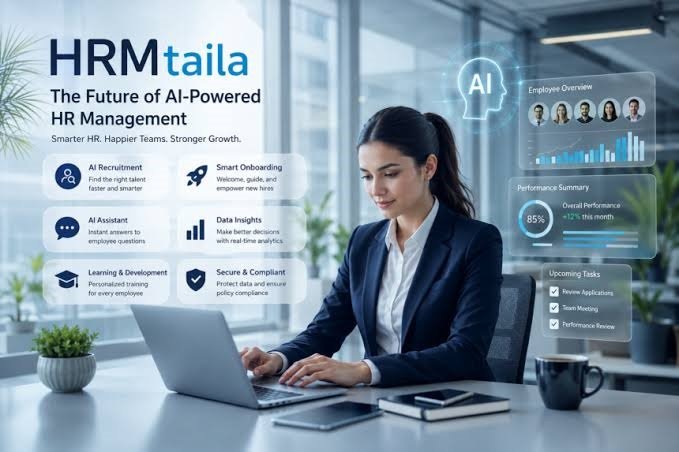
What Is hrmtaila?
hrmtaila is best understood, based on its current online usage, as an emerging term associated with artificial intelligence and human resource management. The exact origin of the name and a single authoritative definition have not been clearly documented in reliable public sources.
The “HRM” portion naturally suggests Human Resource Management, while the rest of the term does not have a confirmed official explanation. Some online articles interpret the whole word as a label for intelligent or AI-supported HR processes, but that should be treated as an interpretation rather than established etymology.
In practical terms, the concept points toward a familiar technology trend: using software and AI to reduce repetitive HR work, organize workforce information, support employee services, and help teams analyze workplace data.
hrmtaila Quick Facts
| Aspect | What is currently known |
|---|---|
| Term | hrmtaila |
| Main online association | AI and human resource management |
| Definition | Emerging and not universally standardized |
| Confirmed major software brand | Not clearly established |
| Common topics | Recruitment, automation, employee records, analytics |
| Best way to evaluate it | Verify the source, company, product, and documentation |
Is hrmtaila a Real Software Platform?
This is one of the most important questions surrounding the keyword. At present, there is limited reliable public evidence showing hrmtaila as an established commercial HR platform with a clearly identified developer, public pricing, extensive product documentation, or a long-standing customer base. Recent pages discussing the term make a similar distinction between the emerging keyword and a verified software product.
That does not prove that no product could use the name. A new company, internal project, startup, or software service could adopt it later. It simply means readers should not assume that a website describing the term has independently verified the existence of a complete HR platform.
This is especially important when an unfamiliar technology name is accompanied by claims about proprietary AI, guaranteed hiring improvements, payroll automation, or advanced workforce intelligence.
How hrmtaila Relates to AI in HR
The broader AI-in-HR market is real and already includes tools for sourcing candidates, screening applications, drafting job descriptions, answering employee questions, analyzing workforce information, and supporting administrative workflows.
The UK Department for Science, Innovation and Technology notes that AI-enabled technologies are being used across recruitment stages including sourcing, screening, interviewing, and selection. The same guidance stresses the need for assurance, governance, fairness, transparency, and risk management.
This broader context helps explain why hrmtaila is often associated with intelligent HR management. The concept fits a wider shift from systems that mainly store records toward systems that can search data, automate workflows, generate insights, and assist decision-making.
However, AI assistance does not automatically mean better decisions. The International Labour Organization has highlighted how unclear objectives, biased or incomplete data, and opaque system design can undermine AI-supported HR practices.
Potential Uses of hrmtaila
If hrmtaila is used as a general label for AI-powered HR technology, several practical applications make sense.
Recruitment and Candidate Screening
AI can help recruiters organize applications, identify relevant skills, summarize resumes, and prioritize work for human reviewers. These capabilities can reduce repetitive administrative effort, particularly when application volumes are high.
Still, screening systems should be monitored closely. The UK government’s responsible-AI guidance warns that AI-supported recruitment can create unfair bias, discrimination, and digital exclusion if systems are poorly designed or deployed.
Employee Onboarding
A connected HR system could streamline onboarding by managing document requests, introductory schedules, policy information, training tasks, and employee questions.
The benefit is less manual coordination. New employees can receive consistent information while HR staff focus on exceptions and more personal support.
Workforce Analytics
Another possible use is turning HR records into useful summaries. Managers may want to understand staffing levels, turnover patterns, skill gaps, attendance trends, or training participation.
Analytics can improve visibility, but the quality of the result depends heavily on the data. A polished dashboard cannot fix inaccurate records or an inappropriate measurement target.
Employee Support
AI assistants can answer routine questions about HR policies, benefits, leave processes, internal forms, or workplace procedures.
This can make basic information easier to access, especially in larger organizations. Human review remains important when questions involve sensitive employee circumstances or interpretation of company policy.
Administrative Automation
One of the clearest benefits of intelligent HR software is reducing repetitive work. Automated reminders, document routing, scheduling, reporting, and data entry can give HR teams more time for employee-facing responsibilities.
The real value should therefore be measured by workflow improvement rather than by whether a product simply uses the word “AI.”
Benefits Associated With hrmtaila
When discussing hrmtaila as an AI-oriented HR concept, the potential advantages are similar to those of broader digital HR automation.
Efficiency can improve when routine tasks move from manual processing to automated workflows.
Consistency may improve when employees receive standardized information and processes are documented in one system.
Faster access to information is another advantage. Search and analytics can help HR teams retrieve workforce data without checking multiple spreadsheets or disconnected systems.
Scalability can also matter. A structured digital workflow may handle a growing workforce more easily than manual processes alone.
There is also a strategic benefit. When administrative tasks consume less time, HR professionals can spend more attention on workforce planning, employee development, communication, and organizational needs.
These benefits are possibilities, not guarantees. They depend on implementation quality, data accuracy, staff training, system controls, and the suitability of the technology for a specific organization.
Risks and Limitations to Consider
The biggest mistake is treating hrmtaila as a verified technology solution simply because multiple websites describe it confidently. Search visibility is not the same as independent validation.
Unclear Product Identity
A legitimate software platform should normally have identifiable ownership, official documentation, clear contact information, terms of service, privacy information, and evidence of how its system works.
Without those basics, a buyer cannot easily determine what they are actually purchasing.
Data Privacy
HR systems contain sensitive information such as names, contact details, compensation data, employment records, and performance information. Any AI-based HR system handling such data requires careful scrutiny of storage, access controls, retention, and third-party sharing.
Government guidance on responsible AI recruitment emphasizes data protection and impact assessment when AI systems process personal information.
Bias and Fairness
AI systems can reproduce patterns contained in their training or operational data. NIST has noted that biased or incomplete data can contribute to harmful AI outcomes, including inaccurate employment-related assessments.
For that reason, automated hiring or performance recommendations should not be accepted blindly. Organizations should test outcomes, monitor for disparities, and maintain appropriate human oversight.
Over-Automation
Not every HR decision should be automated. Employment decisions can affect livelihoods, workplace relationships, privacy, and career opportunities.
The ILO has warned that technology may automate weak processes rather than solve them.
A strong HR workflow uses technology to assist people, not to remove accountability from people.
How to Evaluate an hrmtaila Claim
Before trusting a website, app, or service connected with the term, use a simple verification process.
First, identify the organization behind it. Look for a legal company name, verifiable address, leadership information, and an established online presence.
Second, check whether official product documentation exists. Look for feature pages, user guides, technical information, security policies, pricing details, and support channels.
Third, investigate the source of claims. A blog repeating another blog is not the same as evidence from the product owner, independent customers, regulators, or recognized industry organizations.
Fourth, examine privacy and security practices before entering employee information. HR data should receive much greater scrutiny than ordinary marketing data.
Finally, test whether the technology solves a genuine business problem. A recognizable workflow improvement is more meaningful than vague claims about revolutionary AI.
Common Mistakes When Researching hrmtaila
One common error is assuming that a newly popular keyword automatically represents a mature company or application. Another is copying unsupported claims about founders, pricing, app availability, customer numbers, or proprietary features.
A third mistake is confusing the broader field of AI in human resources with one specific product. AI in HR is a real and expanding area, but that does not prove that every new name associated with the topic represents an established technology vendor.
The safest approach is to separate what is verified, what is a reasonable interpretation, and what remains unknown.
What the Future Could Mean for hrmtaila
The future of hrmtaila depends on what the term eventually becomes. It could develop into a recognizable product name, remain an informal label for AI-assisted HR workflows, or fade from search results as other terminology becomes more popular.
The broader trend behind it is unlikely to disappear. Organizations continue exploring automation, workforce analytics, digital employee services, and AI-assisted recruitment.
What will matter most is not the label but the underlying technology. Useful HR systems need reliable data, understandable processes, strong security, responsible governance, and clear human accountability.
Final Thoughts on hrmtaila
The clearest way to approach hrmtaila today is with curiosity and verification. Current online sources largely connect the term with AI-powered human resource management, but they do not establish one universally recognized definition or clearly verified commercial platform.
For readers researching the keyword, that uncertainty is not a reason to ignore it. Instead, it is a reason to check primary sources, distinguish emerging concepts from established products, and evaluate any HR technology on evidence rather than marketing language.
The strongest lesson is simple: understand the technology behind the name, verify the organization making the claim, and protect employee data before adopting a new HR solution. That approach provides a much clearer picture of what hrmtaila may represent and whether it has practical value for a real workplace.