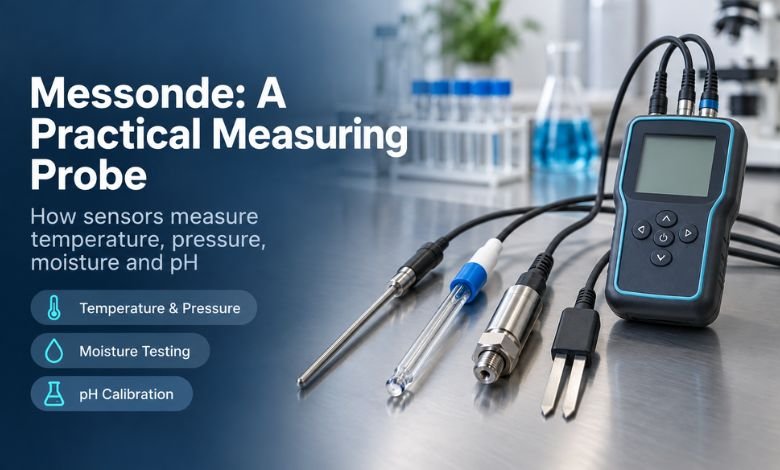
What Is Messonde?
Messonde is a term that can lead to different search results because the spelling is not a standard, widely established English technical term. In technical contexts, it is commonly associated with the German word Messsonde, which refers to a measuring probe, test probe, or measuring sensor.
That distinction is important because a measuring probe is not one specific product. It is a category of equipment used to detect or measure a physical or chemical property, such as temperature, pressure, oxygen, conductivity, humidity, radiation, or another measurable condition.
The term can therefore be understood best by looking at its context. Someone reading a German engineering manual may be dealing with a genuine measurement device, while someone encountering “messonde” on a modern website may see an entirely different interpretation.
Messonde Meaning in Technical Contexts
In engineering and measurement technology, the closest established term is Messsonde. German-English references translate Messsonde as “measuring probe” and “test probe,” with related translations such as measuring head or measuring sensor.
The German compound makes sense linguistically. “Mess” relates to measurement, while “Sonde” refers to a probe. The complete technical term therefore describes equipment used to obtain a measurement.
A measuring probe normally works as one part of a larger system. The sensing element interacts with the environment, a signal is generated, and another component interprets that signal to produce a useful reading.
For example, a probe inserted into a liquid might measure temperature or conductivity. A probe installed in industrial equipment might monitor pressure or another process variable.
Messonde vs. Messsonde
One of the biggest sources of confusion is the spelling.
Messsonde is the established German technical term. The spelling Messonde appears online as a shortened, altered, or incorrectly typed version, and it can also be used as a standalone online term. Current search results show that the shorter spelling is being used in several different contexts, which makes it important not to assume that every result refers to the same thing.
This difference becomes especially relevant when searching for manuals, product specifications, replacement parts, or engineering documentation.
A useful search strategy is to combine both spellings:
| Search Term | Likely Purpose |
|---|---|
| messonde | General search and newer online usage |
| Messsonde | German technical terminology |
| measuring probe | English technical equivalent |
| test probe | Testing and instrumentation contexts |
| sensor probe | Broader sensor-related searches |
| Messsonde + measurement type | More precise product research |
| Using the correct technical spelling can help uncover documentation that a simple search for messonde might miss. |
How Does a Messsonde Measuring Probe Work?
A measuring probe works by responding to a property that needs to be measured. The exact operating principle depends on the sensor technology inside the probe.
A basic measurement chain often looks like this:
- The probe interacts with the material or environment.
- A sensing element responds to the measured property.
- That response becomes an electrical, optical, or other measurable signal.
- Electronics process the signal.
- A display, controller, computer, or data logger presents the result.
Consider a temperature probe. Its sensing element changes in a predictable way as temperature changes. The connected measuring instrument interprets the signal and converts it into a temperature value.
The same general concept applies to many other measurement systems, but the sensing technology changes according to the application.
Types of Measuring Probes Associated With Messonde
Because Messonde is connected with the broader concept of Messsonde, there is no single probe design that represents every use. Different measurements require different technologies.
Temperature Measuring Probes
Temperature probes are used in laboratories, industrial plants, HVAC systems, manufacturing equipment, food processing, and environmental monitoring.
Important specifications include measurement range, accuracy, response time, physical size, and resistance to the surrounding environment.
A probe designed for routine indoor measurements may have very different requirements from one operating continuously inside a high-temperature industrial process.
Pressure Probes
Pressure probes measure the force exerted by gases or liquids. They are used in hydraulic and pneumatic systems, industrial processing equipment, machinery, and monitoring applications.
Selecting one involves more than checking the desired pressure range. Users also need to consider the medium being measured, operating temperature, connection method, material compatibility, and environmental conditions.
Oxygen Probes
Oxygen probes can measure oxygen concentration in liquids or gases. They have applications in water analysis, environmental science, laboratories, industrial processes, and other specialized systems.
The required probe depends on whether the measurement involves dissolved oxygen, gaseous oxygen, or a particular process environment.
Conductivity Probes
Conductivity probes are frequently used when analyzing water and other liquids. Electrical conductivity can provide information about the presence of dissolved ions and changes in solution characteristics.
Temperature can influence conductivity readings, so some systems use temperature compensation to improve measurement consistency.
Humidity and Environmental Probes
Environmental measurement systems may use probes to monitor humidity and other atmospheric conditions. These devices can support building management, storage facilities, manufacturing environments, agriculture, research, and weather-related monitoring.
The probe must be appropriate for the expected range and operating environment because condensation, dust, temperature changes, and contamination can affect performance.
Radiation Probes
Specialized probes can detect and measure radiation for scientific, industrial, environmental, and radiation-protection applications.
These instruments have particularly important calibration and maintenance requirements because measurement quality can influence safety decisions.
Material and Thickness Probes
Industrial inspection can involve probes designed to measure coating thickness, material characteristics, dimensions, or surface properties.
These devices are useful for quality control because measurements can identify differences that may not be visible during a basic visual inspection.
Where Are Messonde-Related Technologies Used?
The usefulness of measuring probes comes from their ability to convert real-world conditions into data.
In manufacturing, probes can monitor temperatures, pressures, levels, chemical conditions, and equipment performance. Measurements can then feed automated control systems or quality checks.
In laboratories, measuring probes allow researchers and technicians to monitor specific variables during experiments and testing.
In environmental science, sensors can gather information from air, water, soil, and other surroundings. These measurements support research and long-term monitoring.
In water treatment, specialized probes can help monitor conductivity, oxygen, pH, and other parameters important to process control.
In engineering maintenance, measurements can help identify unusual operating conditions and support troubleshooting before equipment issues become more severe.
The exact application depends on the probe’s sensing principle and the system in which it operates.
Is Messonde the Same as a Sensor?
The words sensor and probe are related, but they do not always describe exactly the same component.
A sensor is the element that detects a physical or chemical phenomenon. A probe is often the assembly that positions or protects the sensing element and allows it to interact with the material or environment being measured.
For example, a probe may include a sensing element, protective housing, cable, connector, and other components. A separate transmitter or controller can then process the signal.
In some modern products, the sensor and electronics are integrated into a single compact unit. In other systems, they remain separate.
This is why replacing a probe based only on appearance can be risky. Two devices may look similar while using different sensing technologies or electrical interfaces.
Why Calibration Matters for Messonde Devices
A probe can be sophisticated and still produce inaccurate results if it is poorly calibrated or incorrectly installed.
Calibration provides a way to compare measurement performance against a known reference. Depending on the device, calibration may be required periodically, after maintenance, or when accuracy problems are suspected.
Several factors can affect measurement quality:
- Contamination on the sensing surface
- Incorrect installation
- Extreme temperatures
- Mechanical damage
- Electrical interference
- Sensor aging
- Chemical exposure
- Operation outside the specified range
Drift can also occur over time. A probe that was accurate when new may gradually change its response as materials age or as the sensor experiences repeated exposure.
That makes maintenance an important part of any measurement system.
How to Choose the Right Messonde
Searching for “messonde” is only the first step. Before purchasing or replacing equipment, identify what the probe actually needs to measure.
Start with the measurement quantity. Determine whether you need temperature, pressure, oxygen, conductivity, humidity, radiation, thickness, or another variable.
Next, establish the measurement range. A sensor that cannot handle the expected minimum and maximum values is not suitable even when its basic measurement type appears correct.
Then consider accuracy and resolution. High-precision laboratory work can require considerably tighter specifications than basic monitoring.
The operating environment is equally important. Ask whether the probe will be exposed to water, chemicals, high temperatures, vibration, pressure, dust, or outdoor conditions.
Finally, check compatibility. Confirm the connector, signal type, controller requirements, mounting dimensions, communication interface, and any software or calibration requirements.
A common mistake is choosing a device based on a familiar name instead of the technical specification sheet.
Common Mistakes When Searching for Messonde
The first mistake is assuming that messonde has one universal definition. Current web usage shows that the term can appear in different contexts, while Messsonde has a clearer established technical meaning.
The second mistake is treating repeated online claims as technical proof. Several websites may publish similar explanations, but repetition does not establish that a definition is official or technically accurate.
Another mistake is overlooking the language of the original source. A German product manual may use Messsonde while an English translation or search query uses measuring probe.
For technical research, primary documentation is generally more useful than generic articles. Product datasheets, manufacturer manuals, engineering references, and established dictionaries can provide the specific information needed to identify a device.
Is Messonde an English Dictionary Word?
The exact spelling messonde should be treated cautiously as an English technical term. Established references support Messsonde as the German term translated as measuring probe or test probe.
At the same time, recent web content demonstrates that “messonde” itself is being used online as a separate expression in some contexts. That means users searching the term should pay attention to the source and surrounding language rather than assuming every result has the same meaning.
This is a good example of why search keywords and dictionary definitions are not always identical.
Messonde and Related “Sonde” Terms
The word Sonde appears in several technical terms. These terms generally identify instruments or probes designed for particular measurement tasks.
A radiosonde, for example, is an atmospheric instrument package used with a weather balloon. Other specialized “sonde” terms can refer to probes designed for specific environmental or scientific measurements.
This broader terminology can be useful when researching equipment because the measurement type is often included directly in the technical name.
Understanding the role of “sonde” also makes Messsonde easier to recognize in German documentation.
How to Research Messonde More Effectively
A smart search process can save considerable time.
First, search the exact keyword to understand the context. Next, search Messsonde and add the suspected measurement type. After that, compare the results with manufacturer documentation or established technical references.
For example, instead of searching only for “messonde,” a more precise query might be:
“Messsonde temperature measurement probe specifications.”
You can also search a model number, manufacturer name, connector type, or measurement range when that information is available.
Screenshots and product photographs can help identify equipment, but they should not replace specifications. Two visually similar probes may have very different electrical characteristics or measurement principles.
Frequently Asked Questions About Messonde
What does Messonde mean?
Messonde is an ambiguous search term. In technical contexts, it is commonly associated with Messsonde, the German term for a measuring probe or test probe.
What is Messsonde in English?
Messsonde is translated into English as measuring probe and test probe, with related technical translations including measuring sensor and measuring head.
Is Messonde a specific device?
No single universal device is defined by the term. A measuring probe can be designed for many different measurements and applications.
Why do people search for Messonde instead of Messsonde?
Possible reasons include spelling simplification, transcription, translation, copied terminology, or uncertainty about the original German spelling. Searching both terms can produce more useful technical results.
Can a measuring probe measure temperature?
Yes. Temperature probes are one of the many types of measuring probes used in laboratory, industrial, commercial, and environmental applications.
Does every Messonde require calibration?
Calibration requirements depend on the specific instrument and application. Precision equipment commonly has defined calibration or verification procedures, so the manufacturer’s documentation should be followed.
Final Thoughts
Messonde is best approached as a context-dependent search term rather than a single product name. In technical situations, the key connection is Messsonde, an established German term for a measuring probe or test probe.
Measuring probes are used across engineering, laboratories, environmental monitoring, manufacturing, water analysis, and many other fields. They can detect temperature, pressure, oxygen, conductivity, humidity, radiation, thickness, and other variables.
The most reliable way to understand messonde is to look beyond the keyword itself. Check the language, measurement type, manufacturer information, technical specifications, and intended application before deciding what a particular search result or device represents.
When searching for messonde, also try Messsonde and “measuring probe.” That simple change can lead to clearer terminology and more relevant technical information.