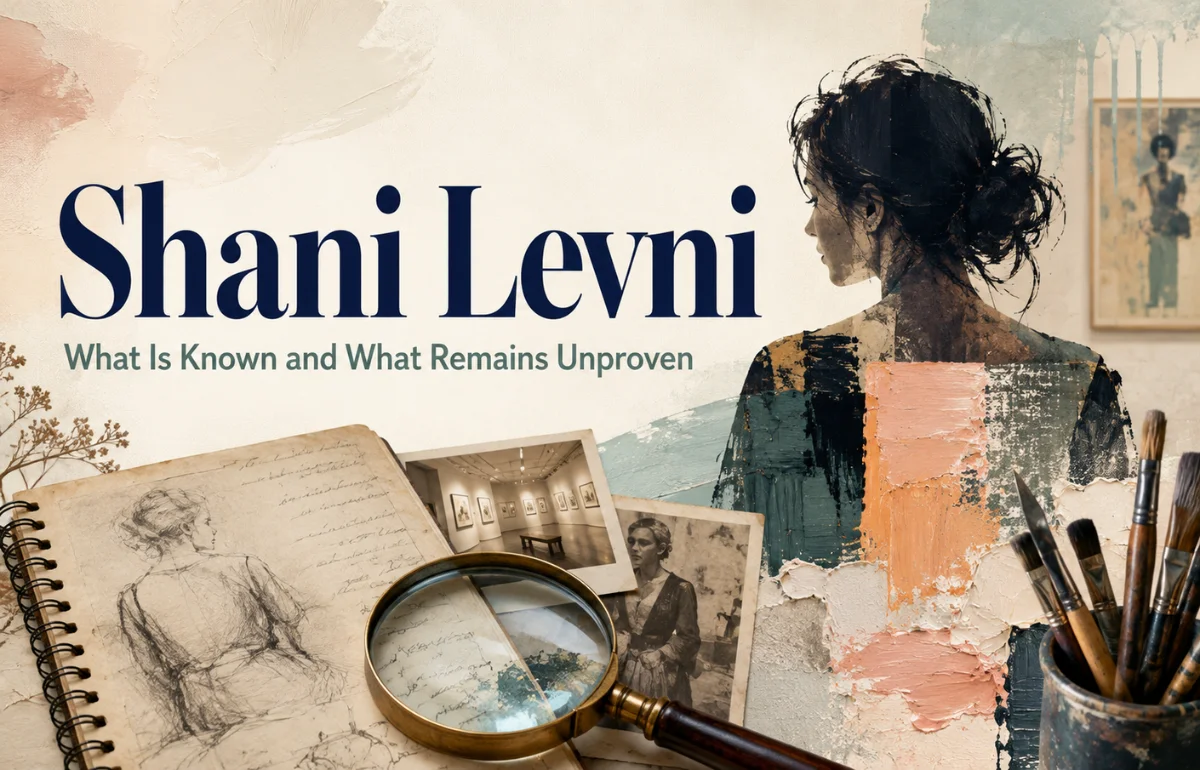
Who Is Shani Levni?
Shani Levni is commonly presented online as a multidisciplinary artist associated with contemporary creative practice. Descriptions of the person connected with this name often emphasize experimentation and the combination of different visual and performance-based forms.
Instead of being associated with only traditional painting, the online narrative around Shani Levni frequently includes photography, installations, mixed-media work, performance, and written expression. This broad approach fits the way many contemporary artists combine different formats to communicate a central idea.
However, the public record surrounding the name is fragmented. A well-written article should therefore avoid presenting every detail found online as an established biographical fact.
Shani Levni and the World of Contemporary Art
Contemporary art often crosses traditional boundaries, and the profiles associated with Shani Levni reflect that model. Paint, photographic imagery, objects, written material, and spatial installations are among the forms mentioned in descriptions of the alleged artistic practice.
The recurring themes are equally important. Online articles often connect Shani Levni with subjects including identity, memory, cultural background, belonging, and the relationship between individual experiences and wider society.
These themes can be understood through a broad contemporary-art lens. Identity-based work often explores how people understand themselves, while memory can provide a way to examine family history, place, culture, and personal transformation.
Artistic Themes Associated With Shani Levni
Identity and Self-Expression
Identity is one of the most frequently mentioned ideas in descriptions of Shani Levni. Art focused on identity can explore personal history, community, culture, gender, geography, or the ways people perceive themselves.
For an artist working across multiple media, identity can also become a visual experiment. Different materials and techniques can represent different aspects of a person’s experience.
Memory and Personal History
Memory is another recurring theme. Contemporary artists often use fragmented images, repeated symbols, old photographs, physical objects, and layered textures to suggest how memories evolve over time.
Descriptions associated with Shani Levni similarly emphasize the connection between artistic expression and recollection. This interpretation gives the name a place within broader conversations about how art preserves or reinterprets experience.
Culture and Belonging
Some online profiles also associate Shani Levni with cultural heritage and belonging. These subjects can examine the relationship between an individual and a particular community, location, language, or tradition.
Such themes are especially relevant in contemporary creative work because artists frequently explore questions surrounding home, identity, migration, heritage, and cultural change.
Why People Search for Shani Levni
There are several reasons the search term Shani Levni can attract attention. First, multiple websites have published biographies containing detailed descriptions of an artist, creating a growing collection of searchable information.
Second, the biographies often include a mixture of artistic, personal, and professional claims. Readers naturally want to determine which details are well-supported and which ones may have originated from secondary sources.
Finally, the name appears in discussions that extend beyond a basic artist biography. This makes the search more complicated than looking up a person with a single official website or a widely documented public career.
The Importance of Verifying Shani Levni Information
One of the most important points for anyone researching Shani Levni is source evaluation.
A biography can appear on many websites and still have a very limited evidentiary foundation. When several pages publish nearly identical details, the information may have been copied, paraphrased, or expanded from an earlier article rather than independently researched.
That distinction matters for writers, publishers, and readers. Repetition can make a statement look authoritative even when there is no primary document supporting it.
A reliable research process should therefore examine where each major claim originated.
Reported Education and Professional Background
Some online articles provide detailed claims about Shani Levni’s education and artistic development. These accounts may mention art studies, professional training, or connections with recognized educational institutions.
Such statements should be checked against institutional archives, exhibition catalogues, official artist biographies, or reputable interviews whenever possible.
Education claims are particularly easy to repeat incorrectly because an institution’s name can make a biography appear more credible. The presence of a prestigious institution in an article does not by itself establish that the person attended it.
Shani Levni and Exhibitions
Exhibition history is another major part of the online narrative. Various articles suggest that the artist associated with Shani Levni has participated in exhibitions or creative events.
For researchers, exhibition claims should ideally be supported by gallery archives, museum records, event announcements, catalogues, or reviews produced close to the time of the exhibition.
This is a useful general rule for online biographies: an exhibition listed in a secondary biography is a lead for research, not necessarily final proof.
How to Evaluate Sources About Shani Levni
Researchers can improve accuracy by applying a simple hierarchy of evidence.
Primary Sources
These include official artist websites, gallery pages, museum databases, exhibition catalogues, verified interviews, and institutional records.
Strong Secondary Sources
Established newspapers, respected art publications, academic publications, and professionally edited reference sources can provide useful independent confirmation.
Weak Secondary Sources
Generic blogs, automatically generated biography pages, copied profiles, and websites with no clear editorial standards require additional verification.
The goal is not to dismiss information simply because it appears online. The goal is to understand how close the source is to the original evidence.
Shani Levni and the Challenge of Digital Biographies
The online story surrounding Shani Levni demonstrates a broader issue with digital biographies. Search engines can index hundreds of pages about a person, yet those pages may not represent hundreds of independent investigations.
This happens when websites republish or rewrite existing material. Over time, an original statement can lose its context and appear more certain than it was when first published.
Readers can avoid this problem by checking publication dates, comparing wording, tracing citations, and looking for independent records.
Common Questions About Shani Levni
Is Shani Levni an artist?
Online sources commonly describe Shani Levni as a contemporary or multidisciplinary artist. The available biographies associate the name with several creative media and recurring contemporary-art themes.
What type of art is Shani Levni associated with?
Descriptions commonly mention painting, photography, mixed media, installation, performance, and writing. The emphasis is generally on a cross-disciplinary approach rather than a single artistic technique.
What themes are linked to Shani Levni?
Identity, memory, belonging, culture, personal history, and social experience are among the themes repeatedly associated with the name.
Is all online information about Shani Levni confirmed?
No. Some information is widely repeated, but repetition does not guarantee independent verification. Specific educational, career, personal, and exhibition claims should be checked against stronger sources.
Why are there so many similar Shani Levni biographies?
Similar biographies can result from websites rewriting or republishing existing information. Researchers should trace important claims back to their earliest identifiable source whenever possible.
Common Mistakes When Writing About Shani Levni
A frequent mistake is presenting an online biography as a definitive record without checking the underlying evidence. Writers may also combine separate claims from different websites and unintentionally create a biography that sounds more certain than the available sources justify.
Another problem is adding precise personal details simply because they appear in search results. Dates, family information, education, awards, and professional milestones should all receive the same careful treatment.
A better approach uses transparent language. When evidence is incomplete, phrases such as “reported online,” “described by several sources,” or “not independently confirmed” can help readers understand the level of certainty.
What Makes a Strong Shani Levni Article?
A high-quality article about Shani Levni should do more than repeat a biography. It should explain the context, identify recurring themes, distinguish source quality, and acknowledge uncertainty where evidence is limited.
It should also avoid filling gaps with speculation. A missing record does not automatically prove that a claim is false, just as a repeated claim does not automatically prove that it is true.
That balanced approach is especially important when writing about people who do not have a large, easily searchable institutional record.
Final Takeaway
Shani Levni is a search term surrounded by a substantial amount of online biographical and artistic content. The person is commonly described as a multidisciplinary contemporary artist whose work is associated with themes such as identity, memory, culture, and belonging.
At the same time, some detailed claims found online require stronger documentation before they should be treated as established facts. For readers and publishers, the most useful strategy is to compare sources, trace claims to primary evidence, and clearly distinguish reported information from independently verified details.
That approach produces a more credible understanding of Shani Levni and helps ensure that future content remains informative, transparent, and useful rather than simply repeating an existing online narrative.