What Is Programgeeks Social Media?
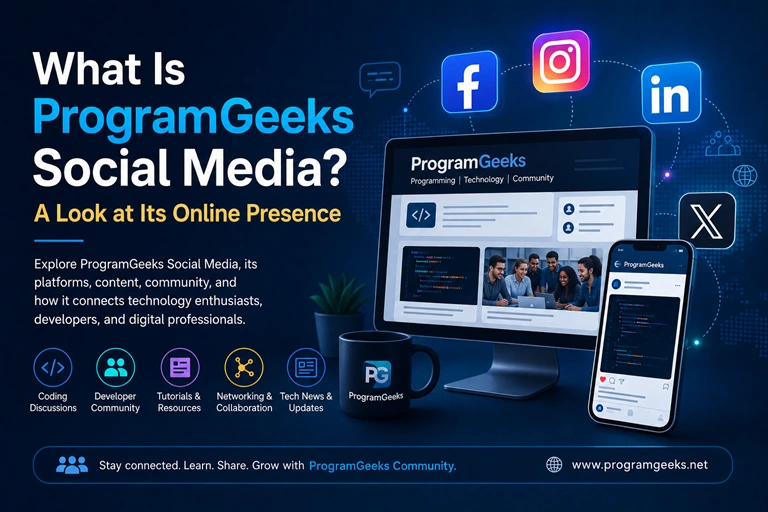
The term is best treated as a broad label for the social and community activity associated with the ProgramGeeks brand. Public ProgramGeeks material connects the brand with technology discussions, programming, digital trends, and online engagement, but public descriptions do not always agree about the exact form of the social offering.
That distinction matters. A company can maintain profiles on established networks without operating a separate social network. One ProgramGeeks article describes coding discussions, project sharing, networking, and developer education, while an independent review says evidence of active groups, private messaging, and extensive member profiles is limited.
The safest interpretation is that programgeeks social media refers to ProgramGeeks-related social presence and technology-focused interaction unless an official page provides direct evidence of a separate platform.
Quick Facts About Programgeeks Social Media
| Topic | Current public picture |
|---|---|
| Main focus | Technology, programming, digital trends, and related content |
| Likely audience | Developers, students, tech enthusiasts, creators, and digital professionals |
| Mentioned social channels | X/Twitter, Facebook, LinkedIn, and Instagram |
| Standalone network | Not consistently verified |
| Potential value | Learning, networking, content discovery, and community engagement |
| Best safety practice | Verify official links before sharing personal data |
| ProgramGeeks’ official About Us page says its editorial focus includes hosting, social media news, crypto, software, and games. |
Why People Search for Programgeeks Social Media
The growing interest in this topic reflects a wider preference for focused online communities. Developers often want conversations about code, software, AI, tools, projects, and industry trends without the constant mix of unrelated content found on broad consumer platforms.
There is also a discovery effect. When a technology website publishes social-media content or discusses community building, readers may naturally assume that a dedicated community is attached to it. Third-party articles can reinforce that assumption by using terms such as “social platform,” “developer network,” or “community hub” without clearly separating verified facts from interpretation.
Search visibility does not prove product existence. Inspect the official site, linked profiles, recent posts, contact information, and domain details before joining or sharing personal information.
Programgeeks Social Media and Developer Communities
A useful developer community should make technical learning more practical. Rather than simply consuming articles, users can compare solutions, ask questions, showcase projects, and learn from how other people approach the same problem.
Public ProgramGeeks content emphasizes themes such as programming tips, industry trends, project sharing, coding challenges, and professional networking. Those topics fit naturally within a developer-focused social environment.
For programgeeks social media to be genuinely useful, though, activity matters more than descriptions. Look for recent discussions, authentic comments, working profiles, knowledgeable replies, and evidence that users return regularly. A page can promise an active network without having much real interaction behind it.
Which Platforms Are Associated With the Brand?
Public ProgramGeeks material mentions X/Twitter, Facebook, LinkedIn, and Instagram, with roles ranging from quick updates to professional networking and visual education.
X or Twitter
X works well for short technology updates, links, announcements, and fast conversations. Developers can also use it to discover release news and technical commentary.
Facebook can support longer discussions, shared articles, community posts, and group-style interaction, which may suit beginners.
LinkedIn is the strongest fit for career-oriented networking. ProgramGeeks-related descriptions associate it with industry insights, professional visibility, and connections between technology professionals.
Instagram favors visual content such as diagrams, short tutorials, coding tips, and project snapshots. Technical accuracy still needs to remain the priority.
A key warning remains: a platform being mentioned in an article does not verify that every account using the ProgramGeeks name is official. One current ProgramGeeks contact page even shows a placeholder for social links rather than clearly displaying account URLs.
What Can Users Gain From Programgeeks Social Media?
The practical appeal of this topic comes from combining information with interaction. For developers and other technology-focused users, that can create several benefits.
Faster Content Discovery
Social feeds can surface tutorials, tool updates, software releases, and useful discussions quickly through people and communities users already follow.
Peer Learning
Documentation explains a concept; discussion shows how it works in practice. Alternative solutions and real mistakes can deepen learning.
Professional Visibility
Sharing a project can demonstrate skills more effectively than a list of technologies on a résumé. Strong posts explain the problem, the approach, the result, and what the creator learned.
Feedback and Collaboration
A public project can attract suggestions, corrections, alternative approaches, or potential collaborators. That feedback loop can improve both the work and the person behind it.
How to Evaluate Programgeeks Social Media Safely
Because descriptions are not completely consistent, verification should come before commitment. Use this checklist:
- Start with the official domain. Look for direct links to social profiles.
- Check activity. Recent, consistent posts are stronger evidence than a dormant account.
- Compare branding. Review names, logos, descriptions, and linked websites.
- Inspect engagement. Genuine technical conversations matter more than follower totals.
- Review privacy information. Avoid giving unnecessary personal data to unverified accounts.
- Check the URL before logging in. Look for suspicious domains, redirects, or spelling changes.
This matters because some third-party articles portray the term as a mature standalone network, while other reviews say the evidence more clearly supports a technology website with social activity and related channels.
Common Mistakes to Avoid
The first mistake is assuming every page that mentions ProgramGeeks is an official source. Repeated wording across several sites can create the appearance of certainty even when the original evidence is weak.
The second mistake is confusing publishing with social networking. A site can publish news, host comments, or link to social accounts without functioning like a full social network.
The third mistake is judging a community only by follower counts. One active discussion with a correct solution may be more useful than thousands of passive followers.
Finally, never share passwords, payment information, or sensitive personal data simply because an account uses the ProgramGeeks name. Verify the account first.
Is Programgeeks Social Media Worth Following?
For developers, programming students, freelancers, and technology enthusiasts, this topic may be worth exploring as a source of technology content and community discovery. The strongest reason to follow programgeeks social media should be the quality of its current activity, not the label attached to it.
Readers should still keep expectations realistic. Current public information does not consistently establish ProgramGeeks Social Media as one large, independent social network. Instead, the available evidence points toward a broader editorial and social ecosystem around ProgramGeeks, while claims about a separate dedicated platform remain inconsistent.
Frequently Asked Questions
What is programgeeks social media?
The phrase generally refers to the social, community, and technology-focused online activity associated with ProgramGeeks. Some third-party pages use the phrase more narrowly for a developer-focused social concept.
Is it a standalone social network?
There is not enough consistent public evidence to confirm a fully established standalone network. Some descriptions suggest a dedicated community, while others describe ProgramGeeks activity across established social platforms.
Which social platforms are associated with ProgramGeeks?
Public ProgramGeeks material mentions X/Twitter, Facebook, LinkedIn, and Instagram. Specific account URLs should be verified through official sources before users follow or interact with a profile.
Who is the target audience?
The broader brand targets technology enthusiasts, developers, business professionals, gamers, entrepreneurs, and digital innovators.
How can readers verify information?
Use first-party pages for the brand’s stated purpose, then compare them with independent sources. Check dates, links, account activity, ownership signals, and whether a claim can be traced to an actual page or feature.
Final Takeaway
The topic sits at the intersection of technology publishing, online networking, and developer-oriented discussion. Its appeal comes from bringing useful technical content closer to people who build, study, and work with technology.
The most important point is to avoid treating the phrase as automatic proof of a standalone social network. Public sources describe ProgramGeeks as a technology-focused brand and associate it with several mainstream social platforms, but claims about a separate, fully developed network remain inconsistent.
For anyone researching programgeeks social media, the smartest approach is to verify official links, evaluate current activity, protect personal information, and judge the community by the practical value it delivers.